When the fear of losing is greater than the desire to win
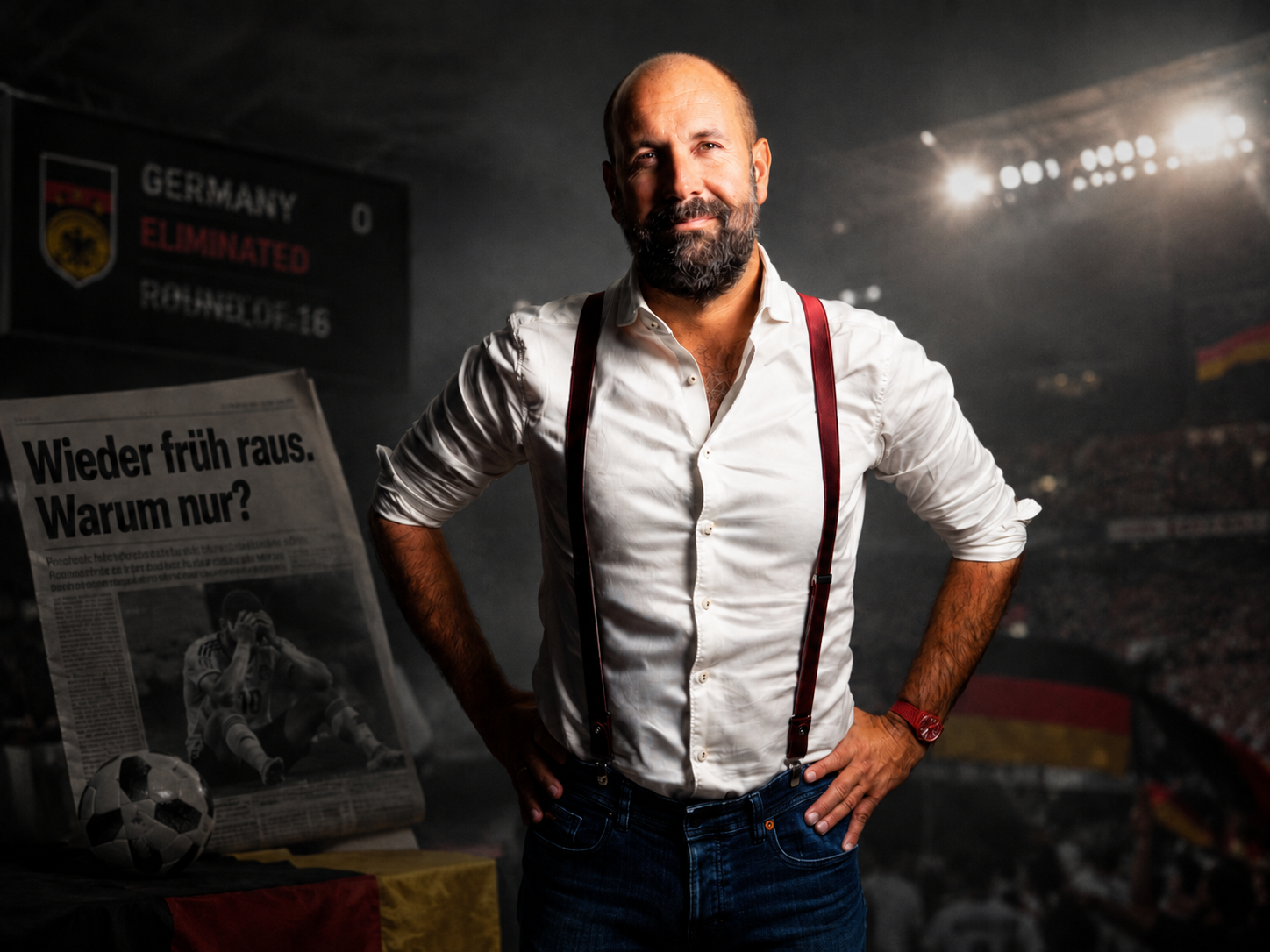
The early exit of the German national team from the World Cup is more than just a sporting disappointment. It is a symptom. Not because football always explains society one-to-one, but because football, like almost no other field, makes visible what happens under pressure: Who takes responsibility? Who remains capable of acting? Who wants to win when losing suddenly becomes real? Precisely for this reason, it is worth analyzing this exit not just tactically. In an interview with t-online, Christopher Spall spoke about performance, attitude, and identity.
What the World Cup exit of the German national team reveals about performance, attitude, and identity
Of course, one can talk about formation, substitutions, set pieces, conversion of chances, and game plans. But my perception is different: this team was not untalented. On the contrary. It was highly talented. But it seemed inhibited.
Inhibited when playing with the ball. Inhibited in moments where clarity was needed. And particularly inhibited when it came to taking responsibility from the penalty spot.
This performance crisis is not just a crisis of football. It shows up in other places as well: in educational results, in economic dynamics, in the self-conception of industries that were long considered untouchable. Naturally, these are different systems. But they are linked by one question:
Do we still have enough desire for performance, responsibility, and shaping our future?
Talent wins games. Personality wins titles.
Germany has footballers with extraordinary potential. Players like Jamal Musiala, Florian Wirtz, or Felix Nmecha represent a generation capable of great things technically, athletically, and creatively. But potential is not yet world-class. Potential is a promise, and world-class is the fulfillment of that promise under pressure.
We have the talent for the World Cup title, but not the attitude and the personalities.
This statement is uncomfortable. However, it is not meant as a devaluation of individual players. On the contrary: precisely because the talent is so great, one must be allowed to ask why this talent does not have an impact in decisive moments.
In competitive sports, greatness is rarely decided in moments when everything comes easily. Greatness shows when the pulse rises, legs become heavy, millions are watching, and the consequence of a mistake is maximally visible. Then talent is not enough. Then it takes personality.
This is exactly where a core challenge of current player development lies. We provide excellent technical training. We measure, scout, analyze, and optimize. But do we also train people who remain capable of acting under pressure?
The penalty spot as a mirror of responsibility culture
The game against Paraguay became particularly symbolic in one moment: when it became visible how heavy responsibility suddenly weighed. When a player like Joshua Kimmich has to struggle to find seasoned national players willing to step up for a penalty, then it is no longer just about technique.
Then it is about attitude.
The penalty is the concentration of pressure in football. The question is: Who sees themselves in this moment as someone capable of bearing responsibility?
The fact that Jonathan Tah ended up in a decisive role, even though he is not a classic penalty taker, says a lot about the mental constitution of a team. Not because Tah took responsibility – that deserves respect. But because others apparently did not want to or could not take it.
National players are role models and should take responsibility even in difficult situations, so that children can see that example being set.
That is the larger point: top athletes are not just athletes. They shape images of what responsibility means. Children and young people observe closely who shows up in difficult moments and who looks away. A performance culture is not created by posters, mission statements, or Sunday speeches. It is created by role models.
In my book "Peak Performer," which I wrote together with Magdalena Neuner and Dr. Christian Grams, we deal intensively with performance pressure. One of my central insights from it is:
The desire to win must be greater than the fear of losing something.
That sounds simple, but it isn't. Because under pressure, it becomes clear what people are truly aligned with internally. Those who primarily want to avoid making mistakes become tighter. Those who primarily want to win remain more agile. Pressure can be exhilarating, but only if there is sufficient internal stability.
External pressure is unavoidable in top-level sports. Fans, media, federations, history, expectations – it's all part of it. The decisive question is not whether pressure exists. The decisive question is how people process it.
How do we manage to perform under pressure?
This is a crucial skill in competitive sports. This skill does not emerge by chance. It is trained and culturally shaped. It arises in families, schools, clubs, youth performance centers, and companies. Everywhere where young people learn whether mistakes are dangerous or enable development. Whether responsibility is rewarded or punished. Whether performance is linked to fear or to purpose.
Germany's problem is not a lack of talent. It is a lack of attitude.
I see an attitude crisis across society as a whole. Not because people don't want to work or because an entire generation is flawed. Such blanket judgments are too cheap. But I perceive that in many places, we are losing our internal grip on performance.
Across society, I observe an attitude crisis. Furthermore, we lack a hunger for performance and the will to take responsibility.
Hunger for performance does not mean self-exploitation. It also does not mean permanently overtaxing people. Hunger for performance means wanting to shape something, to get better, not to be satisfied with mediocrity when excellence would be possible.
People must be allowed to make mistakes without being shamed – and at the same time learn to take responsibility for their development.
A mature performance culture needs two things simultaneously: psychological safety and high standards. This is exactly where the real work begins.
We must start with the youngest and create a positive mindset, teaching children and young people that mistakes are not the opposite of achievement. Mistakes are a component of development. Those who fear mistakes will rarely be brave. Those who are not brave will not take responsibility in the decisive moment. And those who do not take responsibility do not win big games – and do not shape a strong society.
What needs to be done now
The answer to this World Cup exit does not lie in a simple exchange of coaches, players, and systems. The bigger question is: what attitude are we cultivating?
Germany needs a Growth Mindset: the belief in being able to shape things. The courage to make mistakes. The willingness to take responsibility. And the permission to show personality.
Germany needs a hunger for performance again. A desire to win that is greater than the fear of losing.
If we establish this structurally, talent can once again lead to impact. In football. In the economy. In society.
Because in the end, this World Cup exit is not just a sporting defeat. It is an invitation to look closer.
At our understanding of performance.
At our culture of error.
At our culture of responsibility.
At our identity.
And then: to work.
Image source: Spall Identity / KI