The Christian Church as a Brand

A revolutionary example from Great Britain is turning heads: Christ Church Spitalfields, London. This is how branding works for a community of faith.
The decline in membership in German churches continues unabated. Many people have already bid farewell to religious communities in this country. And many are looking specifically for other ways to live out their spirituality. A revolutionary example from Great Britain is making people sit up and take notice. There, over the course of the last seven years, they have succeeded in building a digital church brand.
My experience report on the Sunday service at Christ Church Spitalfields in London contains seven electric shocks that can revitalize more than just our churches. They are the cornerstones on which a strong brand is built in the 21st century, with genuine bonding power and attractiveness.
If the church were a brand, it would be managed as a discontinued model or an 'out-brand'.
8 Electric Shocks to Revitalize the Christian Church
or How to Turn a Community of Faith into a Brand
It is not just the pedophilia scandal that has weakened the attractiveness of the Catholic and Protestant churches. Above all, their services are no longer up to date. The churches remain rigidly stuck in their rituals and customs.
For most people, the churches and services in this country are no longer relevant. Many have already turned their backs on the religious communities entirely. Some stream the few courageous approaches to modern-day services online. The church is aging, both in office and in the audience. If the church were an animal species, it would be classified as endangered.
2.3 Billion Reasons to Stop the Decline of the World's Largest Faith Community
Yet the prerequisites are sensational: 40 million Germans belong to a church. That is still every second person. Worldwide, Christianity is the number one faith community: globally, more than 2.3 billion people believe in Jesus Christ, even if it is not clearly proven that the "product" of the Catholic Church ever existed as handed down. Although the performance of the "Christianity brand" stands on such shaky legs, an incredible number of people identify with it and with the story of Jesus Christ.
His birth and death still dictate our annual calendar. However, the use of the brand is wretched. Its power of identification and reach remains untapped. Never were the prospects for the Christianity brand as miserable as they are now.
Dear churches in Germany, here comes a well-thought-out and fully realized approach from the Protestant Church of England. One that not only brings young people back to church in droves, but simultaneously appeals to families and older people:
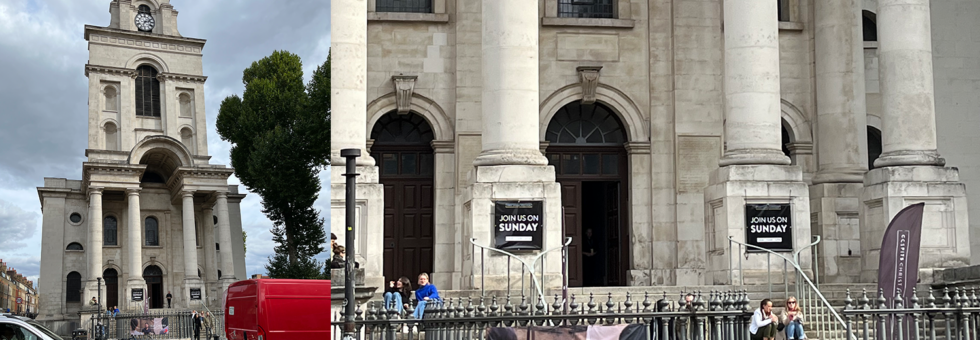
Christ Church Spitalfields, London.
This is how branding works for a community of faith.
Perhaps Jesus is the strongest personal brand of all time.
Already on the steps up to the entrance door, I notice that at least five people welcome me. It's close to forming a guard of honor (no pun intended). "Maybe I've stumbled into a wedding," I think and just keep walking.
Once inside the church, I encounter a reception committee as well. I later learn on the website that these people were the "Sunday Welcome Team." "Now that's a welcome culture!" I think, wondering if such friendliness comes with an admission fee. It doesn't. I head for the sofas. Why there are sofas in the church, I don't care. A sofa is better than a hard chair. There, a sofa without a "Reserved" sign. Great, I'll take that one. Until a blonde lady taps me from behind and asks if I could please sit on a chair, because the sofas are reserved for families with small children. A few families are already approaching behind me. I quickly pack my things and grab a chair.
Church services with children are pure stress for many parents. The pastor's address often goes straight over the kids' heads. The texts of the sermons are complicated, the songs are from ages ago. The children get bored and cranky. This comes at the expense of the attention of all family members. All in all, not a good deal for the family Sunday service. That's why many families stay home altogether. No, a few children's books at the entrance unfortunately don't solve the problem.
Here, at Christ Church Spitalfields, several families of all ages come in shortly after me. The older children are given a yellow pin by youth "tutors," while the little ones are allowed to let off steam in the play area. The tutors wear yellow sweaters so that they can be easily identified by the kids. The tutors then take the children to a separate area.
Bible texts aren't just read out here; instead, music is played and they work with the kids through dialogue and at eye level.
The babies stay with their parents in the lounge area. This is set up next to a rug with toys and toy instruments, where young mothers sink into armchairs with a chai latte while the band starts the first pop(!) song. "What's going on here?" I ask myself.
Technical equipment is everywhere. It looks a bit like a concert. And it turns into one. Because the technology and the sound create an atmosphere like a Coldplay performance. Is this still a church service? Or a spiritual music event with speaking interludes?
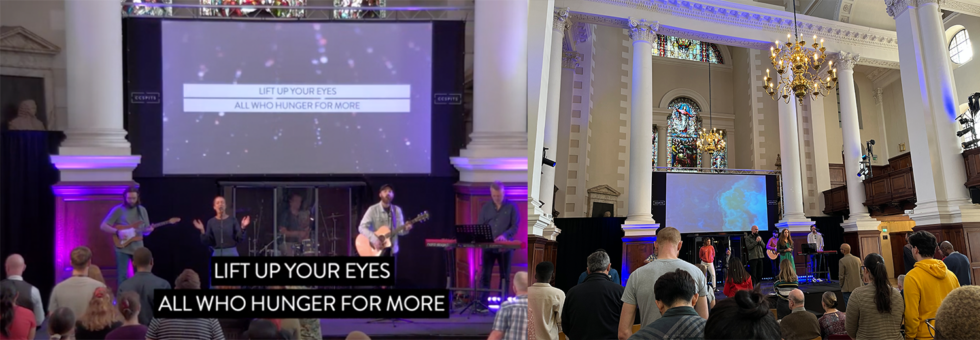
I am impressed by how easy it is made for visitors to participate: the lyrics run on a huge screen.
The collective singing reminds me of SingStar in team mode.
There are no hymn sheets, no hymn books. No one mumbles to themselves with their head down. Every head is up, everyone is looking forward. You can hear it. And you can feel it. Every band member is mic'd up, the sound is magnificent.
Is the church in Germany lacking know-how? Or why else do those preaching here not wear clip-on microphones? In any case, the sound quality in our churches frequently only reminds one of announcements at German train stations. In Spitalfields, by contrast, I am quite amazed. The acoustics are top-notch.
Do so few people go to church here because the presentation is simply not as professional as at comparable cultural events?
It becomes clear to me that every protagonist here is a professional in their field: The pastor is rhetorically extremely skilled and very charismatic. The man giving the sermon uses the entire "stage" and active body language to convey his message. The musicians obviously have great talent. Each of the actors takes the audience with them.
Just as I find myself wishing the event would last a bit longer, the next radical break from the rules occurs: during the collection of donations. Everyone knows the classic collection bag ritual common here. In London Spitalfields, a link appears on the screen behind Pastor Darren—whose physiognomy reminds one more of the drummer of a rock band. You can donate simply via smartphone using that link. The donation platform is, of course, integrated directly into the church's website.
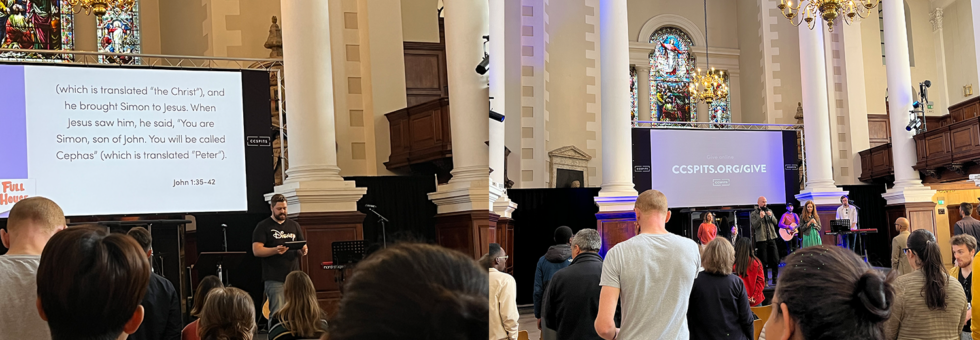
I donate a few pounds just to test the process. It works. My mouth is still hanging open in amazement as I realize that relationship management is also digitally supported. The Christ Church Spitalfields website links directly to Insta, Facebook, and YouTube, so I can connect immediately with the brand "CCSpits," as the church simply abbreviates itself. The services are named "The Eleven" or "The Five" depending on their start time. Needless to say, every service is streamed live online and is available on YouTube a few hours after the event.
The church as a brand is the program here.
This feels unusual. In any case, it is contemporary. And if it makes it easier to reach interested people—why not?
Then the Eucharist begins. Darren explains the procedure for everyone who is new. I listen intently so as not to make any embarrassing mistakes. Everyone should simply take a piece of bread. And one is welcome to dip the bread into the non-alcoholic wine. Only if they want to, of course. Darren's only request is not to drink from the chalice. Was that a joke? Wine in the Catholic Church is reserved for the priest and other selected Eucharistic ministers. It is taboo for the common people. And here everyone is invited to dip the bread in the wine (and please, only for hygienic reasons, not to drink from the chalice)? Wow.
What is unthinkable in the Catholic Church is simply done here.
No one drinks from the chalice. No one is playing Jesus here. No one has special rights.
What has long been practiced across the board in many companies—with cooperative leadership at eye level—is still a pipe dream in most Catholic churches and to some extent in the Protestant church here. CCSpits, on the other hand, lives collaboration at eye level. That is how you win people over.
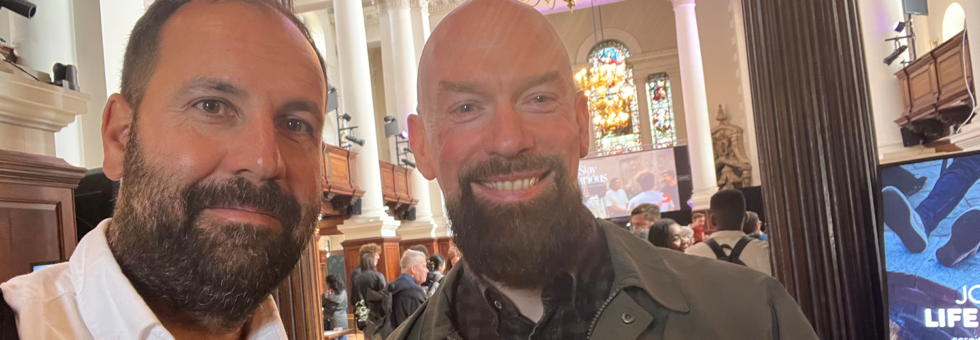
I am a bit confused when Darren, in the middle of the service, calls for people to find a stranger to connect briefly with another human being. But in that same moment, a young lady named Irene turns to me and asks for my name. Irene is a software developer in the City of London. For three years, she has been a regular at the services and active in the community. An interesting conversation develops about life, faith, and work, until after a few minutes Darren transitions to the next pop song. The conversation felt good and wasn't forced. The exchange with the Londoner I didn't know was interesting; the unexpected conversation in this extraordinary situation was valuable to me. Quite unlike the Catholic church in Bavaria, for example, where services take place practically "contact-free." And where a Corona-compliant nod during the sign of peace represents the anonymous peak of "togetherness."
How openness is lived in this church in East London is shown by a look at the website: there you can find a highly visualized annual report that could compete with the sustainability report of a DAX corporation. You find out, for example, how much money was spent on which projects and what the goals are for the coming year.
Transparency is an important success factor for a brand in the 21st century. Customers and employees demand it. Believers do too. This need is met here.
After the service, in any case, no one rushes straight out. Most people stay behind in the church. Specially set-up lounge areas invite people to have a coffee or tea together. Community is at the forefront.
Speaking of community. The CCSpits congregation offers so-called Life Groups. Here, interested parties can join together and meet on shared topics.
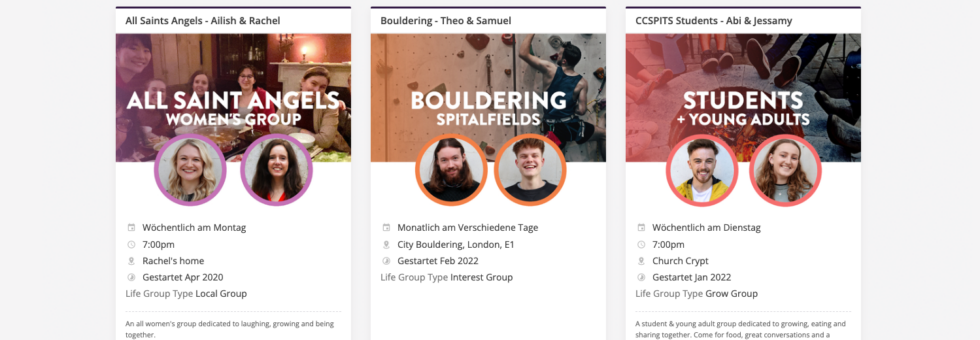
For example, there is a women's group, the All-Saint-Angels. The Angels meet every Monday at 7 a.m. at Rachel's house. In the "Friday Night Youth" group, teenagers go out together. Theo and Samuel lead the bouldering group, which anyone who is interested can sign up for. Registration for the groups and all organization take place online via the congregation's central online hub. A mix of meeting friends, a Tupperware party, a sports club, and, well, church. Some groups also optionally meet via Zoom.
The congregation skillfully picks up on many city dwellers' desire for a sense of community through valuable, target-group-specific offers.
In other teams, everyone can get involved in the church. There is an online survey to ask in which areas people would like to contribute. Options include "Photography" or the "Sunday Welcome Team."
Dancing with Coffee to Go
I notice: none of the protagonists wear robes or other special clothing. There are no altar servers or other assistants. But many people help out. The visitors to the 11 a.m. service don't seem particularly formally dressed either. Sneakers and hoodies are to be seen everywhere. In general, I notice that particularly many young people have come. I can hardly remember the last time I saw so many young people in a Christian church. It must have been at my Confirmation (the Roman Catholic counterpart to the Protestant confirmation) when all the confirmands and their siblings filled the church. I was about twelve then... Next to me stands a young couple with coffee cups in their hands. As they touch me lightly and unintentionally for the second time, I realize that they are dancing.
They're dancing here!—Unimaginable in most Christian churches.

Knowledge of exactly what a church congregation stands for is usually reserved for the initiated. Or it depends solely on the pastor. Or it remains entirely in the fog. The Londoners, on the other hand, make it easy for people to identify with the congregation. This is helped by clear and smart goals published on the website. For example, you learn that the theme- and target-group-specific groups are to be expanded to 36 (!). Alongside these are tangible values. As an interested party, I already get a clear picture of what to expect and what the church stands for on my first website visit. Additionally, all those involved in the congregation are visible online with inviting portrait photos.
I learn something about the people behind the church facade; I can compare my attitude with that of the congregation. And then I can decide whether to drop by or precisely not to. That is how you build a community of like-minded people who identify with a common idea.
My bottom line:
Yes, there are occasional good approaches in individual Protestant and Catholic congregations—and also in other faith communities in this world, such as Gospel or free churches.
The concept of this congregation from East London, so perfected and adapted to the digital age, has lighthouse character. It certainly requires a lot of courage and a willingness to change. And presumably both are more pronounced in the Church of England than in the Christian churches here in Germany. But if the loss of members is to be stopped and the turnaround finally achieved, a radical change of course is needed. The iceberg has already been hit. Those who wait will go down.
The future model of Christian churches needs these 8 cornerstones: a genuine welcome culture, target-group-specific services, professionals, consistent digitalization, less hierarchy, openness, a clearly defined identity, and houses of God that become genuine meeting places again. A large and great task.
Or do you know another brand that has 2.3 billion followers?
Data on the size of faith communities as of 2021:
https://de.wikipedia.org/wiki/Religionen_in_Deutschland
Image source: Foto von Lukas Meier auf Unsplash